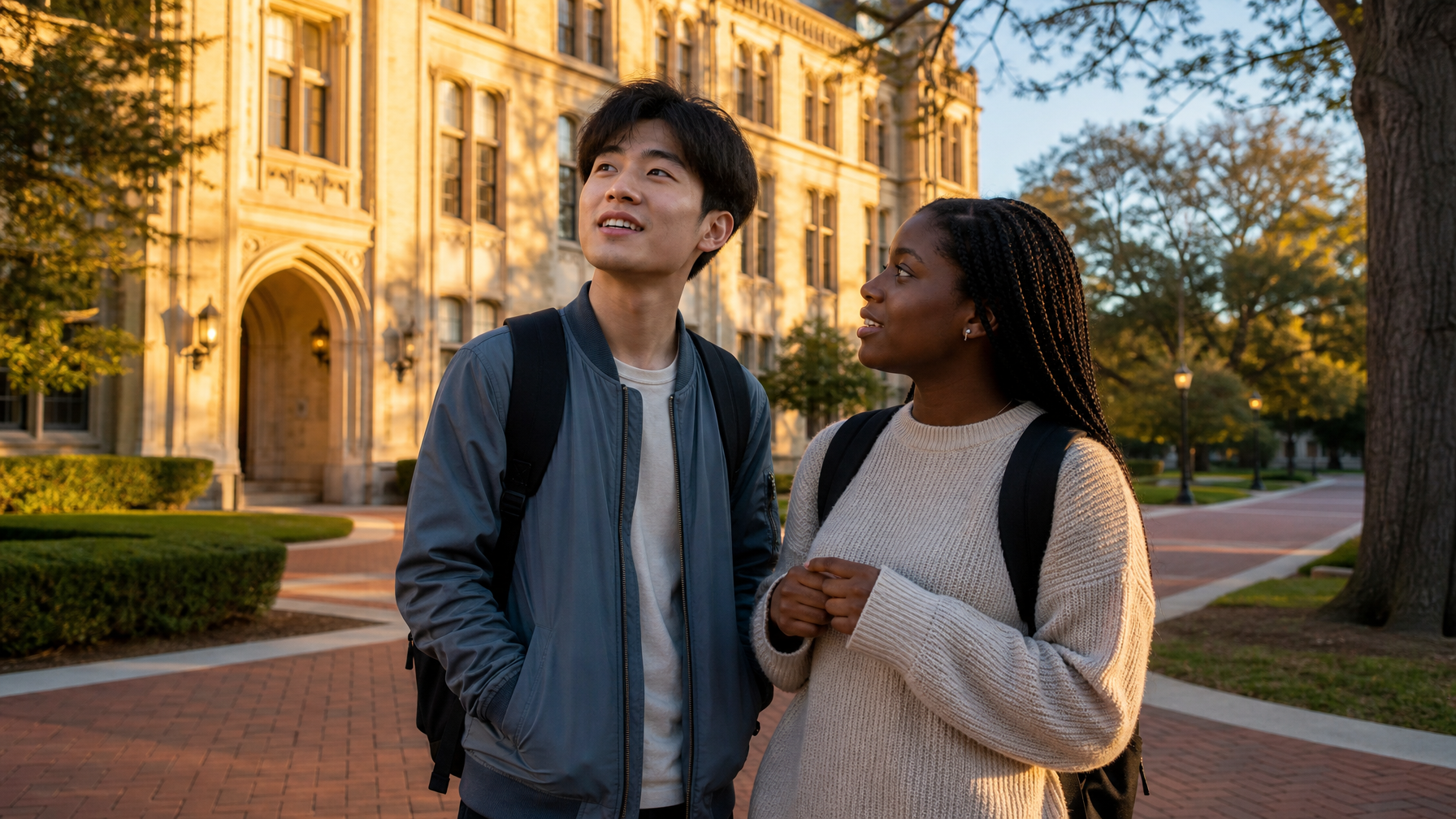
What English Questions Help You Learn More on a U-M Campus Tour?
A University of Michigan campus tour is one of the few extended English-conversation opportunities a prospective international student gets at a target university. The tour guide is usually a current U-M undergraduate, walking with the visiting group for 60 to 90 minutes through the Diag, the Law Quad, the Michigan Union, and the surrounding academic buildings. The information session that often follows the walking tour adds another 30 to 60 minutes of structured presentation and Q&A. Many tours leave time at the end for unstructured questions on the LSA Building lawn or the Diag.
This is a real conversation. The student you talk to is not a marketing employee — they are a current undergraduate whose perspective on U-M is informed by daily experience. Used well, the tour is one of the highest-leverage English-speaking situations a prospective international student gets in a single trip. Used poorly, it produces a polite stream of brochure-language answers and not much information.
This guide walks the question patterns and example phrases that turn a U-M campus tour into a real conversation. The framing is communication, not test prep — these are questions a serious student would actually want to ask, not exam-style prompts.
The Wrong Pattern
Most international visitors fall into a small set of low-yield questions:
"Is the food good?" "Do students like it here?" "Are the classes hard?" "Is the weather nice?"
These get short, vague, polite answers. "Yeah, the food is great." "Most people love it." "The classes are challenging but fair." "The weather is okay most of the year." Polite. Friendly. Almost no information.
The reason these questions fail is that they ask for general assessments. General assessments give the speaker an easy non-answer. Specific instances force the speaker to think and produce concrete detail. Compare:
| Closed/general | Open/specific |
|---|---|
| "Is the food good?" | "Where did you eat for lunch yesterday?" |
| "Are the classes hard?" | "Walk me through your toughest class this semester. What's hard about it?" |
| "Is the weather nice?" | "What was the worst week of weather you remember from last winter?" |
| "Do students like it here?" | "What does a friend you didn't expect to like U-M now love about it?" |
The pattern: open questions start with what, how, walk me through, or describe, and they ask for a specific, concrete instance. The instance is what makes the answer useful.
Five Question Categories That Work at U-M
A productive U-M tour conversation organizes questions around five categories. Two or three questions per category, asked at appropriate moments during the walk, will produce a substantial mental picture of the school.
1. Central versus North Campus daily life
U-M's Central Campus and North Campus feel different. Asking about the difference produces specific answers a website cannot give:
"How often do you go between Central Campus and North Campus on a typical week?"
"What's the best way to spend a Friday afternoon if you live on North?"
"What surprised you about North Campus when you first started taking classes there?"
"If you had a choice today, would you live on Central or North? Why?"
For a prospective Engineering or Stamps applicant, the second and fourth questions are particularly useful — they reveal whether the student found the geographic separation manageable or limiting. A guide who hesitates is telling you something useful even if the spoken answer is positive.
2. The daily academic rhythm
What does a typical week actually look like? Specific instances produce more useful answers than generic descriptions:
"Walk me through your Tuesday. When do you wake up? Where do you eat? What do you do between classes?"
"What does your average week look like in terms of hours per week — class time, homework, jobs, clubs?"
"How big are your classes? How often do you actually talk to professors?"
"When you're stuck on a problem set or a paper, who do you go to first?"
"What's the most useful office hour you've ever attended? What did the professor do?"
These questions reveal class size, faculty accessibility, and the support structures that determine whether a student thrives academically. A tour guide who can name a specific professor or describe a specific office hour conversation is telling you the support structure is real; a tour guide who speaks only in general terms may not have used it.
3. Winter and weather routines
Winter is real in Ann Arbor. International students sometimes underestimate the adjustment. Questions about the winter rhythm produce honest, specific answers:
"What's the first winter like? What do you wish you knew before your first January?"
"How does winter change how you spend your weekends?"
"What kind of clothing did you actually need to buy after you arrived?"
"Is there a week of winter when most students just hide indoors? What do they do?"
"How do you handle the commute between Central and North in February?"
These questions are particularly important for international students from warm climates. A current student who has lived through two or three Michigan winters has practical advice that a brochure cannot match.
4. The community and connections
How do students actually meet each other? Where does the social structure come from?
"How did you meet your closest friends here?"
"What's the most active student organization you've seen, and what do they do?"
"Where do international students from [your country / your region] tend to gather?"
"What's a moment from your first semester when you felt like you found your community?"
"What's it like being a student from outside the United States here?"
The last question is open enough that the guide can take it in whatever direction feels relevant. Tour guides who have themselves been international students or who have international roommates often give the most useful answers to this question.
5. Fit and trade-offs
The harder, more revealing questions:
"What kind of student does well at U-M, and what kind doesn't?"
"If you had to do it again, would you still come here? What would you change?"
"What were the schools you turned down to come here, and what made the difference?"
"What's the most common complaint you hear from current students?"
"What advice would you give to a first-year international student arriving in August?"
These are the highest-yield questions of the tour. Tour guides do not always give complete answers, but the partial answers reveal what the website cannot. A guide who hesitates on "what kind of student doesn't do well here?" is telling you that the answer is real but hard to articulate.
Follow-Up Moves
The first answer to a question is often a polished, brochure-version answer. The second answer — produced by a follow-up question — is usually closer to the truth. Three follow-up moves to learn:
The specific-instance follow-up
Q: "How are professors here?" A: "Generally pretty accessible." Follow-up: "Can you give me an example? Tell me about a professor you actually went to office hours with."
The specific-instance follow-up moves the guide from a general claim to a concrete story. The story is the useful information.
The contrast follow-up
Q: "How is the social life on Central Campus?" A: "Lots going on." Follow-up: "What kinds of students don't fit in on Central Campus socially? Where do they go?"
The contrast follow-up forces the guide out of generic positive statements toward specific differentiation. It often produces the most informative answers of the entire tour.
The example follow-up
Q: "Are there many international students here?" A: "Yes, a lot." Follow-up: "Where do you see them most often? Are there specific clubs or events where international students gather?"
The example follow-up turns a yes-or-no answer into a concrete location or organization. Whether or not the example matches the general claim is the most useful information.
Useful Phrases for U-M Conversations
A small set of conversational phrases that work well in this register:
- "What does X look like in practice?" — turns a generic answer into a specific story.
- "Walk me through..." — invites narrative; produces step-by-step concrete answers.
- "Tell me about a time when..." — invites a specific instance.
- "What surprised you about..." — invites the speaker to reveal something unexpected.
- "In your own experience..." — explicitly opens the question to the speaker's specific story.
- "What would you tell yourself a year ago?" — produces honest, advice-shaped answers.
- "How does that compare to what you expected?" — invites contrast between expectation and reality.
A useful conversational rhythm: ask one question, listen to the full answer without interrupting, ask exactly one specific follow-up, and then move on. The pattern is: question → full answer → follow-up → answer → next topic. Resist the impulse to interrupt with multiple follow-ups in rapid succession.
Asking About Specific U-M Schools
If the prospective applicant is interested in a specific school — Engineering, Ross, LSA, SMTD, Stamps — additional school-specific questions produce useful detail:
For Engineering applicants
"How active are the project teams? Which ones have you worked on or seen up close?"
"What's the Duderstadt Center like at 11 PM on a weeknight?"
"How does the common first-year curriculum compare to choosing an engineering major right away at other schools?"
For Ross BBA applicants
"What's the cohort feel like? How tight-knit are first-year BBA students?"
"How early in the year does recruiting start? What was your first internship search like?"
"What's the most useful thing the Ross career office did for you?"
For LSA applicants
"How did you choose your major? When did the decision actually happen?"
"What's an LSA class you took outside your major that surprised you?"
"How do you balance the breadth requirements with depth in your major?"
For SMTD or Stamps applicants
"What does a typical studio day look like?"
"How do you balance studio time with general education courses?"
"What's the audition or critique culture like? How do you get feedback?"
These school-specific questions work best after the general tour, in conversation with a current student in that specific school. School-specific tours through the relevant U-M school's admissions office are often the right venue for these questions.
What to Avoid
A few patterns that produce poor answers:
- Asking the same question every prospective student asks. "How is the dining hall?" gets the same polished answer every tour. Try "where do students who are tired of the dining hall go to eat?" instead.
- Asking about prestige or rankings. Tour guides cannot meaningfully answer; the answer is always some version of "we're great." Direct your prestige questions to your university research, not to the tour.
- Asking purely about logistics that you can find on the website. Tour time is precious; spend it on questions that require a human answer. "How many students live on North Campus?" is on the website. "How do North Campus students actually feel about the commute?" is not.
- Asking only as a parent. If the prospective student is on the tour, the prospective student should be asking the questions. The tour guide will answer differently when speaking student-to-student than when answering a parent.
- Long preambles before the question. International English learners sometimes feel the need to explain context before asking. The tour guide does not need the preamble; the question alone is fine.
Practicing Before the Trip
Two practical exercises to do before a campus visit:
Write 10 questions in advance
Write down 10 questions, organized by the five categories above. Two questions per category. Read them out loud. Trim any that sound generic ("Is the food good?"); rewrite them as specific-instance questions ("What did you eat for lunch yesterday?"). Practice the wording until it feels comfortable to say.
Plan one follow-up per question
For each of your 10 questions, write down one specific follow-up question that you would ask depending on a vague answer. This pre-thinking is what produces the on-the-spot follow-up move during the actual tour.
Conversation practice
Ask a friend or family member to play the role of the tour guide and run through your 10 questions and follow-ups. The first time through, the rhythm will feel awkward. The second or third time, the questions will start to feel natural to ask out loud. The goal is for the actual tour to feel like the third or fourth conversation, not the first.
After the Tour
Within 30 minutes of finishing the tour, write down what you learned. Specific quotations are more useful than general impressions. "The tour guide said the toughest class she's taken was a 200-level economics seminar with about 25 students" is more useful information than "the small classes seem nice." The specific notes are what you will look at when comparing schools at the end of a multi-school visit week, and they are also what produces concrete details for the U-M supplementary essays during senior year application season.
A campus tour conversation is also a low-stakes practice opportunity for English-language conversation skills that transfer well beyond admissions visits. The patterns — open questions over closed, specific instances over general assessments, follow-ups over single questions — work in informational interviews, networking conversations, internship interactions, and the general adult skill of getting useful information out of a conversation. The tour gives you 60 to 90 minutes with someone whose job is to answer your questions. Used well, it is one of the most concentrated language-and-decision-making opportunities a prospective international student gets in a single visit.