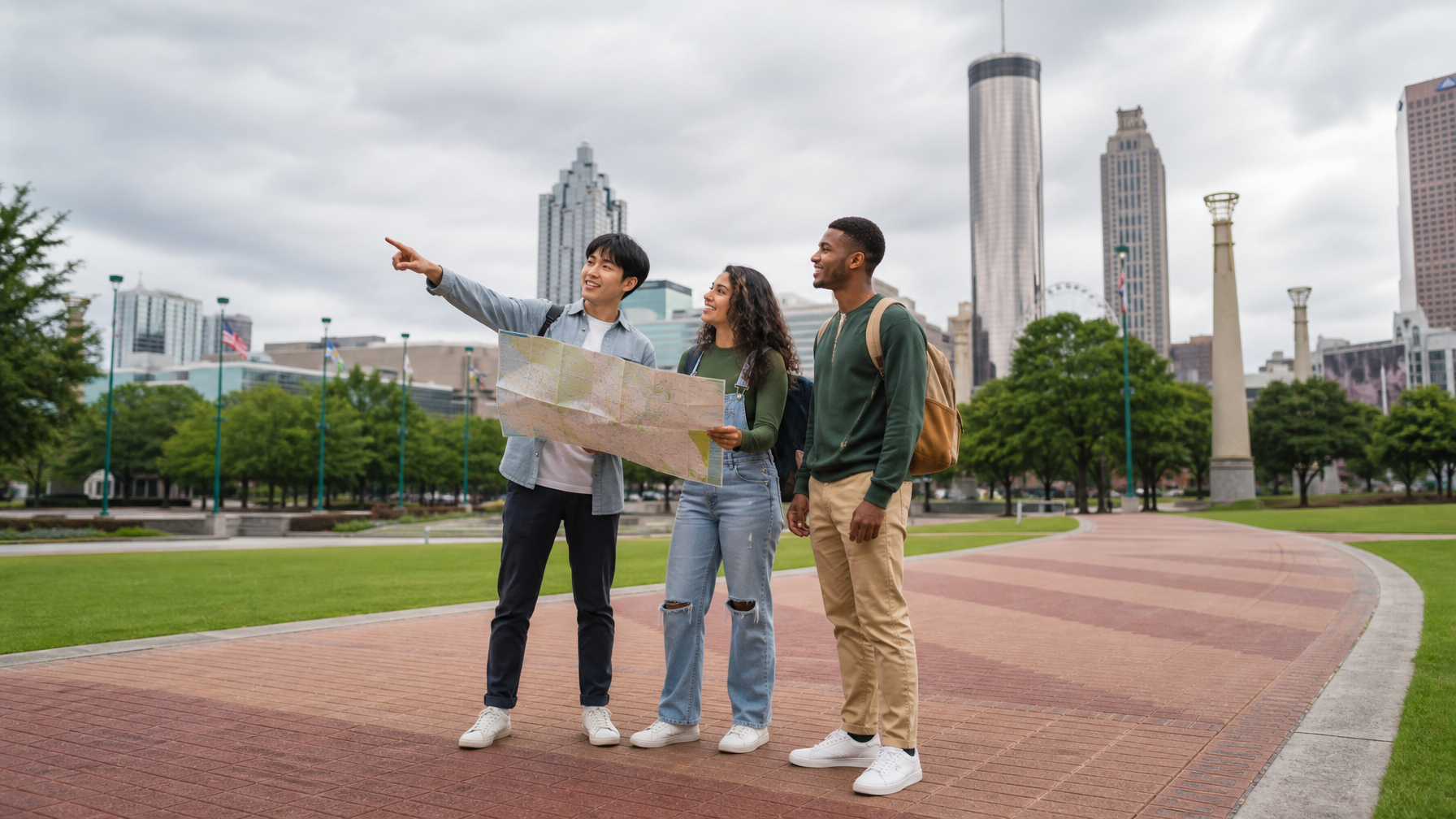
What Should First-Time Visitors See in Downtown Atlanta?
Downtown Atlanta is denser than first-time visitors expect. Within a walkable radius of Centennial Olympic Park sit the Georgia Aquarium, the World of Coca-Cola, the National Center for Civil and Human Rights, the College Football Hall of Fame, and the Mercedes-Benz Stadium and State Farm Arena sports complex. A short MARTA ride or a 20-minute walk away, the Martin Luther King Jr. National Historical Park and the Sweet Auburn corridor anchor the city's civil rights history. None of this requires a car.
For a first-time visitor or a prospective student making an initial Atlanta visit, downtown is the right starting point. The major paid attractions are concentrated, the civil rights history is internationally significant, and the Five Points and Peachtree Center MARTA stations make access from the airport or other neighborhoods straightforward.
This guide walks the canonical first-visit downtown day with what to see in what order, where to eat, what to skip, and how to handle the heat. For broader context, see the BeltLine day plan and the universities city map elsewhere in this series.
What Downtown Atlanta Looks Like
Downtown Atlanta has three loose zones that matter for first-time visitors:
- Centennial Olympic Park core — the cluster of major paid attractions around the park, anchored by the Aquarium and World of Coca-Cola. This is what most people mean when they say "downtown attractions."
- Five Points and the South Downtown blocks — older office towers, the original commercial heart of Atlanta, the Peachtree Center skybridge complex, and the streets around the Capitol.
- Sweet Auburn and the King Historical Park — east of the core, walkable in 15-20 minutes from Centennial Olympic Park, the historic African American commercial corridor and the King family's neighborhood and church.
A first-visit day uses all three zones. The morning anchors at one of the major paid museums, the afternoon walks through Sweet Auburn, and the evening returns to the central blocks for dinner.
Before You Go
Tickets to book in advance
The major paid attractions all use timed-entry ticketing and all have substantial price differences between advance online purchase and walk-up at the gate. Buy in advance whenever possible.
- Georgia Aquarium — book through the official Georgia Aquarium site. Verify current pricing and closing-time rules before going. Combo tickets with the World of Coca-Cola sometimes offer modest savings.
- World of Coca-Cola — timed entry; verify on the official site.
- National Center for Civil and Human Rights — timed entry recommended in busy seasons; verify on the official site.
- College Football Hall of Fame — timed entry; verify pricing and hours on the official site.
- CityPass or similar — Atlanta has had bundled-attraction passes in the past; verify current options before booking individual tickets if you plan four or more major attractions in a multi-day trip.
For free attractions:
- Martin Luther King Jr. National Historical Park — free admission to most park sites, including the visitor center, the King birth home (limited tours, verify current rules), Ebenezer Baptist Church (visitor access varies), and the King Center. Verify hours on the official National Park Service site before going.
When to visit downtown
Mornings are best. The major paid museums open around 9:30-10 AM, lines build through the day, and Atlanta heat makes midday outdoor walking tougher in summer. A 9 AM start at the Aquarium or Civil Rights center followed by an outdoor afternoon walk is a comfortable pattern from October through May. In June, July, and August, plan more indoor time and shorter outdoor segments — the heat and humidity between noon and 4 PM are real.
Saturdays are the busiest day. Friday and Sunday are slightly quieter; weekday visits are noticeably less crowded but tour groups and school field trips fill some attractions on weekday mornings during the school year.
How to get there
Peachtree Center MARTA station (Red/Gold) is the closest rail station to the Centennial Olympic Park cluster — about a 10-minute walk to the Aquarium. Five Points station is the central transfer hub for all four MARTA rail lines and is a 15-minute walk to the same area.
From Hartsfield-Jackson Atlanta International Airport, the MARTA Red/Gold Line connects directly to Five Points in about 20 minutes. For visiting families with luggage, the airport-to-downtown rail trip is one of the simplest urban-transit experiences in the South.
Driving works but parking in the Centennial Olympic Park zone is paid and not always cheap. For a single-day downtown visit, MARTA plus walking is usually the better choice. For broader directions and transit phrasing in real moments, see the directions and transit English-skills article.
A Full Downtown Day for First-Time Visitors
The structure: morning at one major museum, late morning at a second, lunch in the area, afternoon walking the Sweet Auburn corridor and the King Historical Park, evening dinner downtown. Plan on 8-10 hours.
9:00 AM — Coffee and warm-up
Start with coffee somewhere near your hotel or near Peachtree Center. The coffee scene in downtown proper is thinner than in Midtown or the BeltLine corridor — most options near the major attractions are either chain coffee or hotel coffee bars. A quick-serve breakfast somewhere in your hotel or near Peachtree Center is the pragmatic choice.
9:45 AM — Walk to Centennial Olympic Park
Walk to Centennial Olympic Park. Built for the 1996 Summer Olympics, the park is the central public space of downtown Atlanta and the gateway to the cluster of major paid attractions. The Fountain of Rings and the surrounding lawns are pleasant for a morning walk-through; in summer the fountain is genuinely refreshing for kids.
10:00 AM — Choose your morning anchor
Three options for your morning museum, depending on your family's interests:
Option A: Georgia Aquarium
Georgia Aquarium is one of the largest aquariums in the Western Hemisphere and the most-visited single attraction in the downtown cluster. Highlights typically include the Ocean Voyager exhibit (a multi-million-gallon tank with whale sharks and manta rays), the Cold Water Quest (Beluga whales and Pacific Northwest species), the dolphin presentation, and the river-and-tropical exhibits. The aquarium is family-friendly across all ages and one of the strongest indoor stops in the city for younger children.
Allow 2.5-3 hours for a full visit. The acrylic tunnel through the Ocean Voyager tank is the canonical photo moment.
Option B: National Center for Civil and Human Rights
National Center for Civil and Human Rights is the museum that anchors Atlanta's claim as the heart of the American civil rights movement and connects that story to broader global human rights history. The American civil rights gallery covers Atlanta's central role through Dr. King, Andrew Young, John Lewis, and the Student Nonviolent Coordinating Committee; an immersive lunch-counter exhibit asks visitors to sit and experience a sit-in simulation; the global human rights gallery extends the story to international movements.
For prospective students interested in history, public policy, civil society, or law, this museum is the more substantial first-visit choice than the Aquarium. Allow 2 hours. Content is appropriate for age 10 and up; younger children may find the lunch-counter simulation intense.
Option C: World of Coca-Cola
World of Coca-Cola is the corporate brand museum for Atlanta's most famous home-grown company. Exhibits cover the history of the Coca-Cola company, the secret-formula vault (which is more theatrical than informative), bottling and packaging history, advertising memorabilia, and the well-known "tasting room" where visitors sample over 100 Coca-Cola products from around the world. The tasting room is genuinely fun; the rest of the museum is brand storytelling, which some visitors love and others find marketing-heavy.
Allow 90 minutes. This is a strong family stop for younger kids and a reasonable second-priority museum for adults.
12:30 PM — Lunch
Lunch options near the Centennial Olympic Park cluster:
- The downtown food trucks that occasionally cluster around the park
- Quick-serve options along Marietta Street or near Peachtree Center — sandwiches, salads, fast Mexican, fast Asian
- The hotel restaurants of the major chains in the area, useful for families wanting a sit-down with kids
- Walk to Sweet Auburn Curb Market — about a 15-minute walk east. This is the better food choice if your afternoon is the King Historical Park anyway. The historic public market houses a number of stalls including Southern food, Caribbean food, soul food classics, and a butcher counter.
For a more substantial sit-down option:
- Mary Mac's Tea Room — Atlanta's iconic Southern restaurant, slightly off the immediate downtown core but a 10-minute rideshare or 20-minute walk. Fried chicken, collard greens, sweet tea, peach cobbler — the canonical Southern lunch experience. Consider a reservation in busy seasons.
2:00 PM — Walk to Sweet Auburn and the King Historical Park
After lunch, walk east toward Sweet Auburn — the historically Black commercial corridor along Auburn Avenue. The walk from Centennial Olympic Park is about 20-25 minutes through downtown. Alternative: take the MARTA bus along the corridor or rideshare a short distance.
Sweet Auburn was, in the early twentieth century, one of the wealthiest African American commercial districts in the country. Black-owned banks, insurance companies, newspapers, and businesses built a substantial professional and commercial community here. The corridor declined in the postwar era as integration paradoxically drew Black wealth away from the segregated commercial neighborhoods that had been forced into existence; the corridor is now in active revitalization.
Highlights to walk past:
- Sweet Auburn Curb Market — historic public market, still operating
- Auburn Avenue Research Library — a research branch focused on African American culture and history
- The historic Royal Peacock Club building — once a major venue for Black musicians during segregation
- Streetscape with Civil Rights markers — the city has installed historical markers along the corridor
2:45 PM — Martin Luther King Jr. National Historical Park
The walk continues to the Martin Luther King Jr. National Historical Park. The park, run by the National Park Service, includes:
- The visitor center — exhibits on King's life and the civil rights movement
- King's birth home at 501 Auburn Avenue — limited-capacity tours when available; verify current rules
- Historic Ebenezer Baptist Church — where King and his father preached. Visitor access varies; verify on the National Park Service site
- The King Center — operated separately from the National Park Service, includes the tomb of Dr. King and Coretta Scott King and an eternal flame
- New Ebenezer Baptist Church — the larger congregation building across the street, often open for visitors
Allow 90 minutes to 2 hours for a meaningful visit. The site warrants quiet attention; treat it the way you would treat a major national memorial. The visitor center's exhibits are the right starting point if you have not pre-read about the movement.
For families with school-age children, this stop is one of the most educationally substantial in the entire Atlanta visit. For prospective students considering Atlanta universities, the King Historical Park is essential context for understanding what Atlanta has been and what its civic identity claims to be.
For deeper civil rights context including the Atlanta University Center, the civil rights history article elsewhere in this series covers the broader story.
5:00 PM — Walk back toward downtown
Walk back along Auburn Avenue toward the Centennial Olympic Park area. By this point in the day, the sunlight is shifting toward late afternoon and the downtown skyline takes on a soft warm tone. The walk is about 25 minutes.
If you have energy and there's time before dinner, options for a final downtown stop:
- College Football Hall of Fame — strong family stop for football-curious visitors; closes earlier than other museums, verify current hours
- A return to Centennial Olympic Park for the late-afternoon light and the fountain
- Walk through the Peachtree Center skybridge complex — the elevated walkways through the Marriott Marquis and the surrounding office towers are a small architectural curiosity from the 1970s; the Marriott Marquis atrium in particular is one of the most photographed indoor spaces in Atlanta
6:30 PM — Dinner
Dinner options near downtown:
- Sweet Auburn Curb Market — if you didn't eat lunch here, an early dinner works
- A return to a Mary Mac's reservation if you couldn't fit it in for lunch
- Old Lady Gang in Castleberry Hill — Southern soul food, just south of downtown, slightly away from the tourist core
- Castleberry Hill generally — a small loft-and-gallery district just south of downtown with several sit-down restaurants
- Slutty Vegan — Atlanta's well-known plant-based burger phenomenon; multiple locations including one south of downtown. The name is intentional; the food is celebrated locally and the lines tell the story
- The Varsity — Atlanta's iconic drive-in fast food institution at the edge of Tech Square, north of downtown. Hot dogs, chili dogs, onion rings, frosted oranges, and the canonical "What'll ya have?" ordering ritual. A piece of Atlanta history and a strong family stop, especially for kids
For broader food guidance covering Buford Highway, the AUC, and the wider Atlanta scene, see the food guide article.
What Younger Siblings Get
The downtown day is genuinely strong for younger siblings. The Georgia Aquarium is one of the strongest indoor stops in the city for any age. The Coca-Cola tasting room is a sensory novelty kids remember. Centennial Olympic Park's Fountain of Rings (in summer) is a small water-play moment. The College Football Hall of Fame is interactive enough to engage football-curious siblings. The Sweet Auburn / King Historical Park stretch warrants more parental guidance for younger kids — the content is meaningful but heavy. Plan a snack break partway through, walk slowly, and let the markers and the visitor center do most of the explaining.
For older siblings and prospective students, the National Center for Civil and Human Rights is the more substantial museum visit; the King Historical Park is the more substantial historical experience. Together they're the spine of why Atlanta matters in American civic history.
What to Skip on a First Visit
A few items that show up on visitor lists but are usually worth deferring:
- Underground Atlanta — historic underground commercial complex, has gone through multiple revitalization attempts; for a first-time visitor it is rarely a strong stop
- CNN Center tour — CNN has scaled back the studio tour offering significantly; verify current options before planning
- State Farm Arena and Mercedes-Benz Stadium tours outside of game day — only worth it if your family is sports-focused
- Trying to fit Aquarium AND Civil Rights AND Coca-Cola AND College Football Hall in a single day — you will be exhausted. Pick two for the morning, leave the rest for a second downtown morning
- Driving downtown if you can avoid it. MARTA is the better choice for the central blocks
- Stone Mountain as part of a downtown day. It is a 30-40 minute drive east and warrants its own context-conscious half-day; the civil rights history article covers the broader complications
What Not to Miss
- The Civil Rights Center's lunch counter simulation, even if you visit no other gallery
- The Aquarium's Ocean Voyager tunnel, even if you only do an hour
- Walking past the King birth home at 501 Auburn Avenue, with quiet attention
- A Southern lunch somewhere on the trip — Mary Mac's, Paschal's, or the Curb Market — for the canonical food experience
- The Coca-Cola tasting room, regardless of your feelings about the larger museum
- Late afternoon light in Centennial Olympic Park — small payoff but a meaningful end-of-day moment
Handling the Heat
Atlanta is warm. From late May through late September, midday temperatures in the 90s°F with high humidity are normal, and afternoon thunderstorms appear on short notice. A few rules:
- Plan major outdoor walking for before noon or after 5 PM in summer
- Carry water — the major attractions all have water bottle stations
- Wear breathable clothing — cotton, linen, or athletic synthetics
- Sunscreen especially for the Sweet Auburn walk
- A thin rain jacket or compact umbrella in the daypack — afternoon thunderstorms are real
- Plan an indoor activity for 1-3 PM in summer — the Aquarium and the Civil Rights Center fill this slot well
How a Downtown Day Fits a Larger Atlanta Trip
For families on a multi-day trip, downtown is best on Day 1 — it orients you to the city center and packages the major paid attractions efficiently. Day 2 and 3 can then move to the BeltLine, the Atlanta University Center, Buford Highway, and the campus visits at Georgia Tech, Emory, Georgia State, or the AUC HBCU campuses. The 3-day itinerary and family 6-day itinerary elsewhere in this series structure both options.
A first-time downtown day, done well, anchors the rest of the visit. The civil rights story, the Olympic-era public spaces, the iconic corporate brand museum, and the surrounding streets give visitors a genuine sense of what kind of city Atlanta has been and what kind of city it claims to be. Pair the day with one BeltLine afternoon and one campus morning and you have the spine of a meaningful first Atlanta visit.