What Is Raleigh-Durham's Environment Like for Students and Families?
Raleigh-Durham sits in the North Carolina Piedmont — the rolling, forested band between the Appalachian foothills to the west and the coastal plain to the east. The metro is roughly 300–500 feet above sea level, with hardwood forests, river valleys, and a network of small creeks and reservoirs that supply both cities. The mountains are about three hours west; the Atlantic beaches are about two and a half hours east. The region's specific environment — humid, four-season, hardwood-forested, occasionally hit by the remnants of coastal hurricanes — shapes what daily student and family life actually feels like, and it changes meaningfully across the year.
For an international family planning a campus visit, the environment matters more than the average temperature suggests. Spring pollen can be aggressive enough to disrupt outdoor plans for visitors with allergies. Summer humidity makes midday outdoor walks unrealistic for half the year. Fall color across the Eno River and Umstead hardwoods produces the most photogenic visit window. Winter is mostly mild but the occasional ice storm can shut transit and tour operations for two or three days. This guide walks the seasonal rhythm, the major parks and greenways, the storm and weather risks, the outdoor routines that current students follow, and a practical month-by-month packing checklist.
The Piedmont as the Environmental Setting
The Piedmont is the geological and ecological transition zone between the Blue Ridge Mountains of western North Carolina and the Coastal Plain east of I-95. The land rolls in low hills, the soil is red clay over weathered rock, and the dominant forest type is mixed hardwood — oaks, hickories, maples, beeches, sweet gums, and tulip poplars — interspersed with pine forests where farms and pastures have regrown.
For the visiting family, three Piedmont features matter:
- Hills and ravines on campus. Both Duke and NCCU sit on visibly hilly land. NC State's Centennial Campus is across a wooded ravine from Main Campus. The Eno River valley north of Durham is genuinely steep in places. Walking shoes matter more than visitors expect.
- Pollen-heavy vegetation. The same hardwoods that produce fall color produce significant pollen in spring. Oaks and pines together drive the visible yellow-green pollen layer that coats cars and outdoor furniture in late March through May.
- A continuous greenway and park network. The Piedmont's creeks and rivers gave both cities natural corridors that have been preserved as parks and greenways, which now form one of the most-walkable park networks in any Southern metro.
The Major Parks and Greenways
The Triangle has a meaningful park network for a metro of its size. The major stops:
State parks
- William B. Umstead State Park — a 5,000-acre state park between Raleigh and RDU airport. Hardwood forests, three small lakes, and a network of hiking, biking, and bridle trails. The park sits visibly close to the airport (you can occasionally hear flights) but feels remote inside. Free admission for day use; verify current rules and any seasonal closures on the North Carolina State Parks site.
- Eno River State Park — a state park along the Eno River north of Durham. Multiple access points, hardwood forests, and one of the strongest hiking networks in the metro. The river itself has rocky stretches that produce wading and small swimming holes in summer. The park is a popular weekend destination for Duke students and Durham families.
City and regional parks
- Lake Johnson Park — a 150-acre Raleigh city park around a 150-acre reservoir on the southwest side of the city, near NC State. Walking and biking trails around the lake, paddle boat and kayak rental in season, and a quiet feel that contrasts with Umstead's wilderness. Used heavily by NC State students.
- North Carolina Museum of Art Park (Museum Park) — a 164-acre outdoor park surrounding the North Carolina Museum of Art, with walking trails, large-scale outdoor sculptures, and the House of the Future. Free; one of the more distinctive cultural-and-outdoor combinations in any US metro.
- Pullen Park — adjacent to NC State, one of the oldest amusement parks in the United States with a carousel, train, and pedal boats. Family-friendly; a strong stop for families with younger children.
- Duke Forest — a Duke-managed 7,000-acre research forest spread across several divisions in Durham, Orange, and Alamance counties. Walking trails are open to the public; the forest is used for both research and recreation. Verify current trail access and rules on the Duke Forest site.
Campus gardens and arboretums
- Sarah P. Duke Gardens — Duke's 55-acre garden complex, free to walk year-round. Historic terraces, the Asiatic Arboretum, and a native-plant garden. One of the strongest campus-adjacent stops in any Triangle visit.
- JC Raulston Arboretum — NC State's 10-acre teaching arboretum on the west side of campus. Free admission; verify hours. A working horticultural collection that demonstrates Piedmont and adapted plants.
- Coker Arboretum — UNC's small arboretum on the north edge of campus in Chapel Hill, integrated with the McCorkle Place quad area.
Greenways
Both Raleigh and Durham have substantial greenway systems. The Capital Area Greenway network in Raleigh runs along most of the city's creeks and includes the Neuse River Greenway on the east side. The American Tobacco Trail runs from south of American Tobacco Campus for over 22 miles into Wake County. Durham has additional greenways along Ellerbe Creek and other corridors.
For a visiting family, the practical use of these greenways is for short morning or evening walks during the visit, especially when the weather makes longer outdoor activity uncomfortable.
Spring (March–May)
Spring is short and uneven. Late March can still have cold mornings; by mid-April most days are reliably warm; by mid-May the trees are fully leafed out and humidity has begun to climb. The visual signature of spring is the burst of bloom — dogwoods, redbuds, azaleas, magnolias — that gives Raleigh its civic nickname (the "City of Oaks" and "Capital City of Azaleas," depending on the source). JC Raulston Arboretum, Sarah P. Duke Gardens, and the surrounding campus landscapes are at their most photogenic from late March through April.
Practical spring notes for visitors:
- Pollen is real. From late March through May, oak and pine pollen produce a visible yellow-green dust on cars, sidewalks, and outdoor furniture. For visitors with pollen sensitivity, pack antihistamines and check daily pollen counts. The first wave (tree pollen) peaks in late March to mid-April; the second wave (grass pollen) peaks in May.
- Rain is intermittent. Spring is one of the wetter seasons; pack a light rain jacket. Rain is usually short and not a full day's washout.
- Temperatures swing daily. A 75°F afternoon can follow a 45°F morning. Layers matter.
- Tornadoes are possible. The Piedmont sees tornadoes most often in spring; they are uncommon, but verify the NWS forecast on storm days. Hotels and campus buildings have shelter protocols.
- Spring break and graduation crowds. Late April and early May produce graduation-related travel demand, especially around the four major universities. Hotel prices rise; restaurant reservations get harder.
For most families, April is one of the strongest visit windows — comfortable temperatures, full bloom, longer days, and the academic year still in session.
Summer (June–August)
Summer in the Piedmont is humid and hot. Highs typically reach the upper 80s to low 90s Fahrenheit (30–35°C) with regular humid stretches; nights cool into the 70s (around 22°C). The combination of heat and humidity produces a heat index that can feel meaningfully hotter than the air temperature, especially on still afternoons. Thunderstorms move through in the afternoon during many summer weeks, often dropping the temperature briefly before humidity returns.
Practical summer notes for visitors:
- Plan outdoor activity for early morning or evening. Midday between 11 AM and 3 PM is realistic for indoor stops only — museums, libraries, the Bullock-equivalent state museums in Raleigh, the Nasher in Durham. Outdoor campus walks should happen before 10 AM or after 5 PM in July and August.
- Hydration is not optional. Carry a water bottle. Refill at campus fountains, museum drinking fountains, and visitor centers.
- Afternoon thunderstorms. Most summer days have a 30–60% chance of a brief afternoon thunderstorm. Build flexibility into outdoor plans.
- Hurricane remnants. From mid-July through October, the remnants of Atlantic hurricanes can move inland over the Carolinas and produce heavy rain, flash flooding, and occasional wind damage in the Triangle. Most events are several days of rain rather than direct hits, but flash flooding on Piedmont creeks is real, and individual storms have caused significant damage. Verify the National Hurricane Center and the local NWS Raleigh forecast during travel windows.
- Mosquitoes and ticks. Pack bug spray. Long pants and closed shoes for state-park hikes reduce tick exposure; check for ticks after Eno River or Umstead trails.
- Tour availability. Some campus tours pause or shift schedules in summer; verify with each university's admissions office.
Summer is a reasonable time to visit, especially for families who can only travel during school break. The trade-off is that the academic-year energy is muted — fewer students on campus, less classroom observation, lower restaurant and event activity in the campus districts.
Fall (September–November)
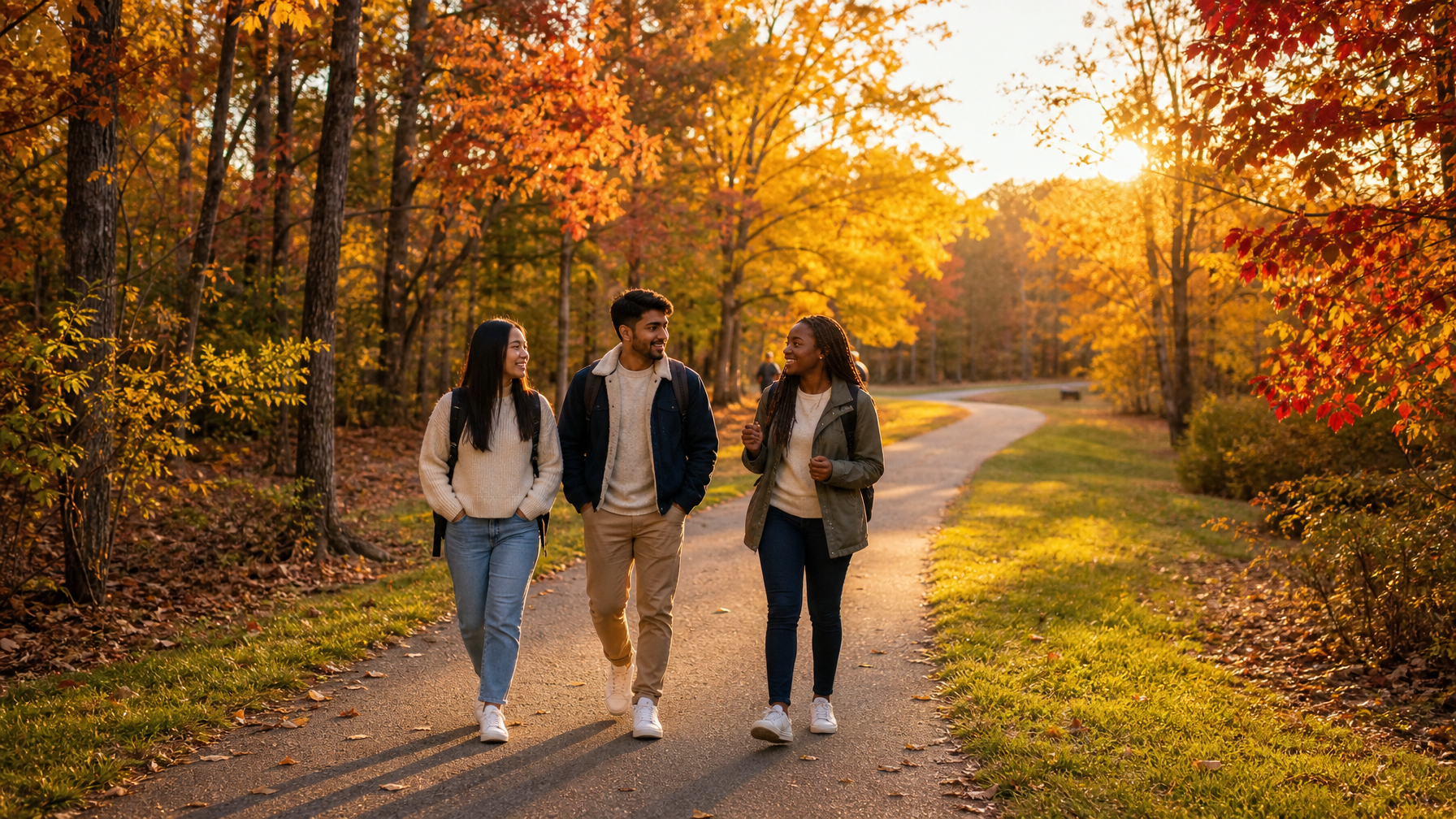
Fall is the season most international families pick for a visit, and with reason. From mid-September through early November, the campus and the surrounding parks are at their most photogenic. Hardwoods turn through yellow, orange, and deep red across the Eno, Umstead, and the campus quads. Football Saturdays produce a specific civic energy. Temperatures are comfortable for walking — typical highs in the 60s and low 70s Fahrenheit (15–22°C) — and the humidity that defines summer has dropped.
Practical fall notes:
- Peak fall color in the Piedmont is typically late October to early November, depending on the year. A campus visit in the third or fourth week of October usually catches it.
- Football and basketball home games transform the cities. Verify the Duke, NC State, and UNC home schedules; decide whether you want a game-day visit. The contrast is significant.
- Layering is essential. A 70°F afternoon and a 45°F early morning is normal in October.
- Rain is intermittent, less concentrated than summer. Bring a light rain jacket.
- Shorter daylight. By late October, sunset is before 6:30 PM; by early November (after the time change), before 5:30 PM. Schedule outdoor activity earlier in the day.
- Hurricane season is technically still open. Through October, occasional storm remnants can affect the Piedmont. November is reliably calmer.
For most international families, mid-October is the strongest single-week window for a Triangle visit.
Winter (December–February)
Winter in Raleigh-Durham is mostly mild by international standards but real. Average daily highs are in the 50s Fahrenheit (around 10–12°C), with cooler stretches into the 30s and 40s. Most precipitation is rain. Snow is occasional — a typical winter brings 1–3 small snow events, totaling perhaps 4–8 inches across the season — and is gone within a few days. The bigger weather risk is ice storms.
Practical winter notes for visitors:
- A regular winter coat plus a sweater handles most days. A heavy down coat is rarely needed. Layering is the right strategy.
- A waterproof rain jacket is more useful than a heavy parka. Most precipitation is rain.
- Walking shoes with traction for occasional ice. Sidewalks and crosswalks can ice over in cold-rain events even when the air temperature is just below freezing.
- Ice storms are rare but disruptive. A Piedmont ice storm — when freezing rain coats trees, power lines, and roads — can knock out power, close roads, ground flights at RDU, and shut campus tours for two or three days. The Triangle gets one or two of these events in a typical winter, but some winters bring none and some bring more. If your visit window aligns with a freezing-rain forecast, build a contingency day. Verify the NWS Raleigh forecast in the days before travel.
- Tour operations generally continue through winter. Verify any weather-related schedule changes with the admissions office.
- Fewer outdoor activities. Greenways are walkable in winter; state parks are open with reduced facility services. Indoor stops — museums, libraries, the Hayti Heritage Center, the Nasher, the NCMA — work well as winter alternatives.
A winter visit is the most-realistic preview of student daily life for the cooler months. Hotels and tours are less crowded; the trade-off is reduced outdoor activity and the small risk of an ice-storm disruption.
Specific Storm and Weather Risks
A few specific risks worth understanding:
- Hurricane remnants (July–October). Most Atlantic hurricanes that affect the Triangle do so as tropical storms or weakened remnants that bring 4–10 inches of rain over 24–48 hours. Flash flooding on Piedmont creeks is the main concern. Hotels and campus buildings have storm protocols. Major airport disruption is possible during the storm window itself.
- Severe thunderstorms (March–September). Strong thunderstorms with wind, hail, and occasional tornadoes are most common in spring and summer. Tornadoes are rare individually but the metro has been affected in past years.
- Ice storms (December–February). Discussed above. The most-disruptive winter risk; unpredictable.
- Heat advisories (June–August). The NWS issues heat advisories or warnings on days when the heat index reaches dangerous levels. Outdoor activity should shift to early morning or evening on these days.
- Air quality (variable). Smoke from distant wildfires has occasionally affected the Piedmont in recent years; verify the AirNow forecast for current conditions.
Insurance for trips that include hurricane-season air travel is worth considering.
Outdoor Routines for Students
Current Triangle students adapt their daily routines to the seasonal rhythm:
- Walking and biking are practical from October through May; July and August require shifting to early morning or evening. Most students use a combination of walking, campus shuttles, bicycles, and rideshare.
- Running and jogging are popular along the American Tobacco Trail, the Capital Area Greenway, and the campus loop routes. Most students adjust pace and time based on humidity.
- Weekend hikes at Eno River or Umstead are a regular Triangle student activity; both parks are within a 20-minute drive of any of the major campuses.
- Coastal beach trips to the Outer Banks or Wilmington-area beaches happen in spring and fall most often; the drive is two to three hours.
- Mountain trips to the Blue Ridge Parkway, Asheville, or western North Carolina happen on long weekends, especially in fall for color and winter for occasional snow at higher elevations.
For a visiting family, building one weekend-style outdoor activity — a 45-minute walk at Sarah P. Duke Gardens, a short Eno River trail walk, or a Lake Johnson loop — into the visit gives a more accurate sense of student outdoor life than the campus tour alone.
A Packing Checklist by Month
| Month | Top Layers | Bottom Layers | Footwear | Other |
|---|---|---|---|---|
| December–February | Mid-weight winter coat, sweater, base layer | Pants | Waterproof shoes; boots if forecast includes ice | Hat, gloves; rain jacket layer; antihistamine if pollen-sensitive (rare in winter but possible warm days) |
| March | Light coat or jacket, sweater | Pants | Waterproof shoes or sneakers | Light rain jacket; antihistamine for pollen sensitivity |
| April | Light jacket, sweater for evenings | Pants or lighter pants | Sneakers | Antihistamine; sunglasses; small umbrella |
| May | Light layer, T-shirt or button-down, sweater for evenings | Lighter pants or jeans | Sneakers | Sunscreen; antihistamine for grass pollen sensitivity; bug spray for park days |
| June–August | T-shirt; light layer for evenings | Shorts or lightweight pants | Sneakers, sandals for casual; closed shoes for parks | Sunscreen, hat, water bottle, bug spray, light rain jacket for thunderstorms |
| September | T-shirt with light layer | Lighter pants | Sneakers | Light jacket for cooler evenings; bug spray; sunscreen |
| October | Layered tops; light jacket | Pants | Sneakers | Light rain jacket; layers for daily temp swings |
| November | Sweater, jacket transitioning to coat | Pants | Sneakers; waterproof preferred | Light rain jacket; warmer layer for evenings |
How Visit Timing Changes the Visit
The same campus walk feels different in October than in February or July. Practical effects:
- Mid-October to early November — peak fall color, comfortable walking, full academic-year visibility, possible football-weekend complications. Most-visually-rewarding window.
- Late March to mid-April — strong bloom, comfortable temperatures, but pollen-sensitive visitors should be prepared. Academic year still active.
- June–August — quieter campus, hotter and more humid outdoor activity, hurricane-remnant rain possible. Suitable for families constrained to school break, with adjusted outdoor scheduling.
- December–February — most-realistic preview of cooler-weather student life. Lower visitor competition for tours and hotels. Small risk of ice-storm disruption.
- Late April / early May — strong campus energy with end-of-semester intensity, but graduation week (typically early-to-mid May at most Triangle universities) produces hotel scarcity and crowded restaurants.
For most international families, the recommendation is mid-October for the best combination of weather, fall color, and academic visibility, with April as a strong second choice. A winter visit is reasonable for families who want a cooler-weather preview; a summer visit is reasonable for families constrained to school break.
What This Means for the Visit Itinerary
The seasonal information above shapes how the family-itinerary articles in this series are structured. The 5-day and 3-day itineraries assume a fall or spring visit by default; the outdoor-heavy days (Sarah P. Duke Gardens, Eno River, NCMA Museum Park, Lake Johnson) work in any season but feel different in summer humidity than in fall color. Indoor stops — the North Carolina Museum of Natural Sciences, the North Carolina Museum of History, the Nasher Museum of Art, and the campus libraries — are accessible year-round and work well as bad-weather alternatives.
For families with full schedule flexibility, mid-October produces the best overall visit. For families committed to a specific window, the packing checklist above and the seasonal notes should make the visit comfortable in any month. Verify storm and air-quality forecasts in the days before travel; the Piedmont weather is mostly predictable but can produce surprises that benefit from a contingency day.
For the broader Triangle context, see the Raleigh-Durham university city map. For specific itinerary planning, see the 5-day Raleigh-Durham family itinerary and the 3-day compressed itinerary. For the parks and family attractions in more detail, see the Raleigh-Durham museums and parks article.